Kanerva Kartano, MA, is a Finnish visual and community artist based in Tampere. She works at the intersection of art, ageing and everyday aesthetics, bringing artistic expertise into social contexts.
Her artistic practice unfolds at the boundary of experience and encounter. It attends to the tones of everyday life — to what remains unnoticed, to the dignity that takes shape in ordinary situations.
Through artistic practice and research, her work explores encounter, everyday aesthetics and ageing, connecting artistic thinking with broader social meaning.
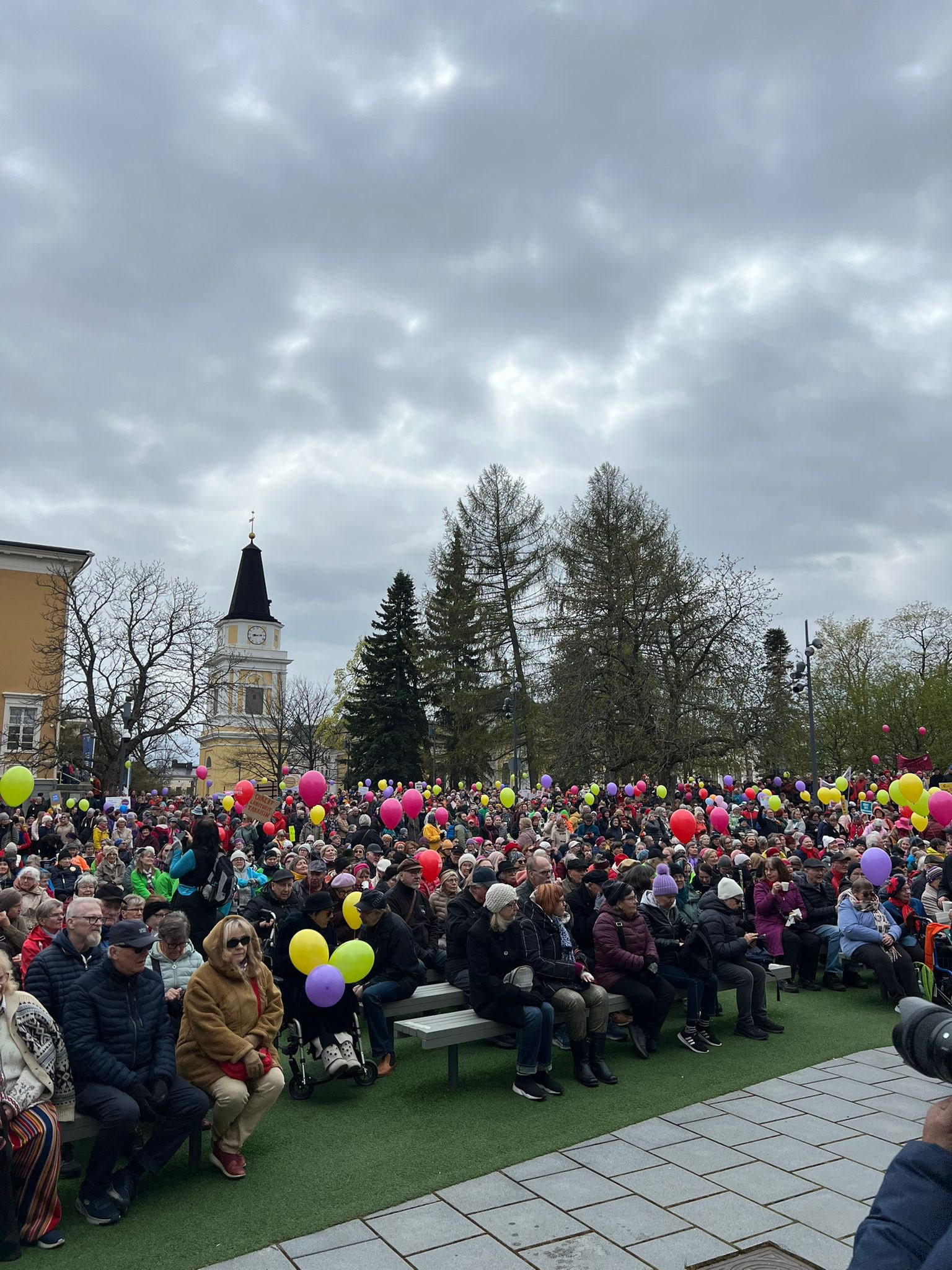
Photo from the main Rollaattorimarssi event on May 9, 2025, in Tampere at the Laikku stage. Photo: Rollaattorimarssi archive. Kartano participated in 2025 as one of the facilitating artists in the Rollaattorimarssi sign workshops and in organizing an exhibition of the protest signs at Kuuselakeskus.
As an artist, my thinking is multisensory and not limited to words alone. These pages present the artistic thinking and philosophical perspective that shape my work. From this foundation, my community art projects emerge, as does my artistic gaze in the everyday lives of older people.
My work explores the aesthetics of ageing and the sensitivity of encounter in everyday life, drawing on the perspective of everyday aesthetics (Saito, 2007). I am interested in what happens between the observer and the observed – in the experiential space where perception, time and intention shape the meaning of a situation.
Through community-based practice, I approach this space by attending to observations and experiences emerging from people, places and situations. Artistic thinking often begins with listening, wandering and noticing, before gradually becoming articulated.
My artistic practice is grounded in visual art and engages with the performative qualities of everyday situations, where ordinary actions shared between people take on significance. From these encounters, verbal, visual, musical or performative expressions may emerge, often created together with people in communities.
In eldercare contexts, this perspective can shift attention away from disease-centred narratives towards the aesthetic and ethical dimensions of ageing. From my position as an artist, I seek to open shared spaces where people may become visible to one another, where new forms of participation and dignity may emerge.